49 CFR Part 565: VIN Compliance Rules

49 CFR Part 565: VIN Compliance Rules
If a VIN is not exactly 17 characters, uses banned letters, fails the check digit, or is filed late with NHTSA, you have a compliance problem. That is the short version of Part 565.
If I had to boil this rule down for a team, I’d focus on four things:
- Build the VIN correctly: 17 characters, uppercase letters, and no I, O, or Q
- Assign it once: no VIN can be reused for 30 years
- Code the right data in the right positions: WMI, VDS, check digit, model year, plant, and serial
- File early with NHTSA: VIN decoding data is due at least 60 days before first U.S. sale
A few points drive most of the work:
- Position 9 is a Mod 11 check digit
- Position 10 carries the model year code, and T = 2026, V = 2027
- Low-volume makers under 500 vehicles per type per year use a different identifier pattern
- For passenger cars and light trucks, positions 13–17 must be numeric
In plain terms: Part 565 is about clean VIN structure, correct filing, and system checks that catch errors before a vehicle ships. I’d treat it as both a legal rule and a data-quality rule, because one bad character can disrupt registration, recalls, insurance, and title records.
The 17-Character VIN Structure Required Under Part 565
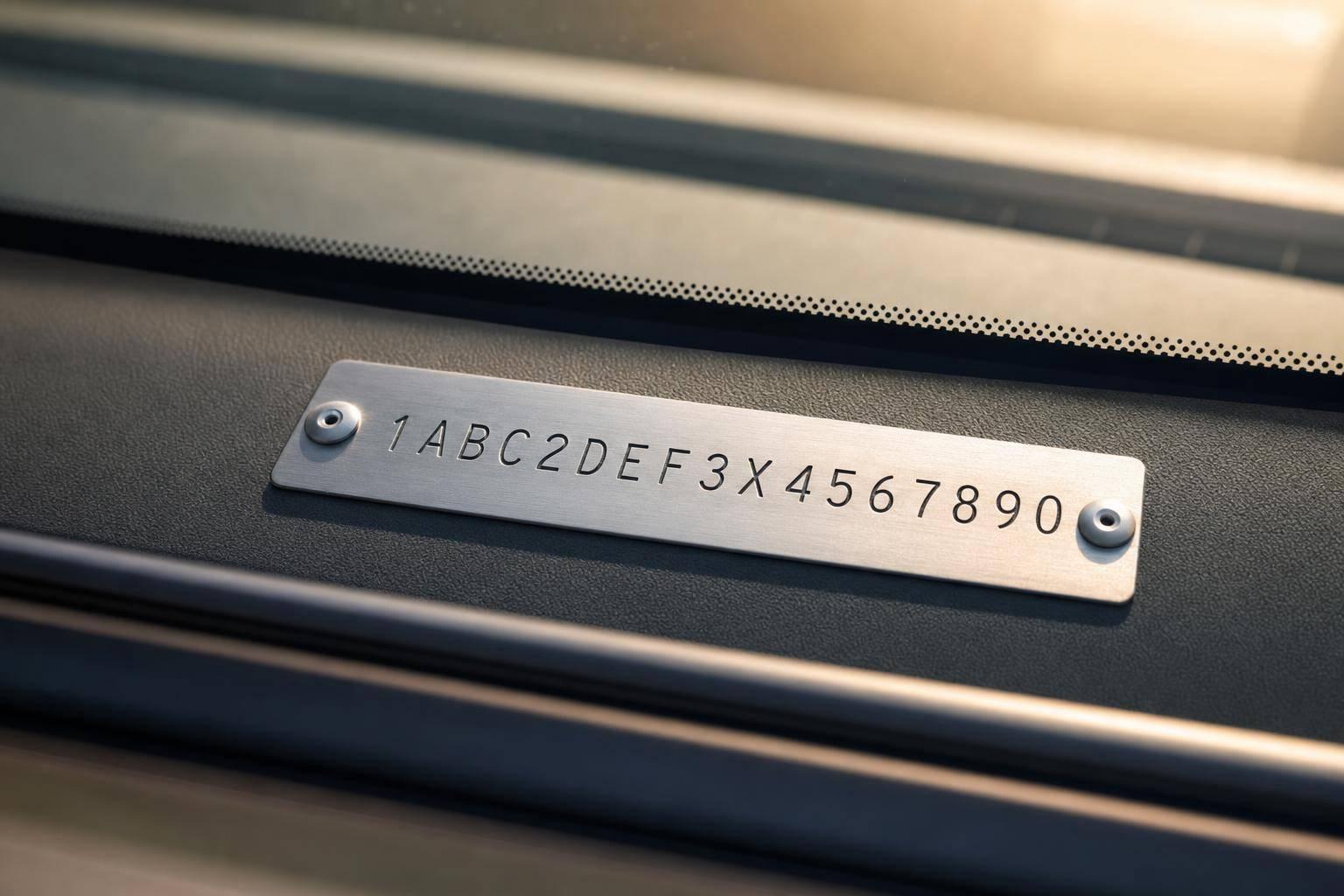
Under Part 565, a U.S. VIN must be exactly 17 characters long. Those characters must use uppercase letters and Arabic numerals. But not every letter is allowed. The only permitted letters are A-H, J-N, P, and R-Z. The letters I, O, and Q are banned because they can be confused with 1 and 0 [2].
That rule may sound small, but it matters. If a VIN includes a banned character, the VIN is noncompliant. And that can slow down registration or even hold up a sale. Each part of the VIN has a specific compliance job: identification, attribute encoding, validation, and traceability. Put simply, the structure controls how manufacturers build each VIN and how NHTSA checks it.
The 17 positions are split into four sections, and each section has its own regulatory role:
Section Positions Purpose WMI 1–3 Identifies the manufacturer and vehicle type VDS 4–8 Encodes vehicle attributes Check Digit 9 Mathematical validation character VIS 10–17 Model year, plant, and production sequence
The sequence starts with the manufacturer identifier, then moves to the descriptor section, the check digit, and the vehicle identifier section.
Positions 1-3: WMI and Manufacturer Identification
For high-volume manufacturers, meaning those that produce 500 or more vehicles of a given type each year, positions 1–3 uniquely identify the manufacturer.
Low-volume manufacturers, with fewer than 500 vehicles a year, follow a different pattern. In those cases, position 3 is 9, and positions 12–14 combine with positions 1–3 to complete the manufacturer identifier. In the United States, manufacturers work through SAE International for WMI assignment.
Positions 4-9: Vehicle Attributes and Check Digit
Positions 4–8 make up the Vehicle Descriptor Section (VDS). This section encodes regulated vehicle attributes, and those attributes change based on vehicle class. NHTSA Table I sets out which attributes are required for each class.
Position 9 is the check digit. This is a calculated character used to validate the VIN. Since I, O, and Q are prohibited, they do not have assigned mathematical values in the regulatory tables, which means a valid check digit calculation cannot be made with them [1][4]. That check matters because it helps systems catch bad VINs before they move into registration or recall workflows.
Positions 10-17: Model Year, Plant, and Serial Sequence
The last eight positions show when and where the vehicle was built. Position 10 encodes the model year using NHTSA Table VII. For example, T stands for 2026 and V stands for 2027. Year codes do not use I, O, Q, or U.
Position 11 identifies the assembly plant. Positions 12–17 carry the sequential production number. For passenger cars and light trucks, positions 13–17 must be numeric. For other vehicles, positions 14–17 must be numeric.
One detail trips people up all the time: model year is a regulatory designation, not a calendar year. For cars and light trucks, position 7 decides whether position 10 maps to 2010–2039 or 1980–2009. If the year code is wrong, decoding falls apart across registration, service, and recall systems.
sbb-itb-9525efd
Manufacturer VIN Assignment and NHTSA Submission Duties
49 CFR Part 565: High-Volume vs. Low-Volume VIN Requirements
After VIN format comes assignment and filing. Manufacturers also need to assign VINs the right way and send decoding data on time. This is the day-to-day side of Part 565: assignment, submission, and validation.
Assigning a Unique VIN to Each Covered Vehicle
Every covered vehicle needs its own VIN, and that VIN can't be reused for 30 years [2]. As 49 CFR § 565.23 states:
"The VINs of any two vehicles manufactured within a 30-year period shall not be identical." [2]
Reusing a VIN can create a mess for title history and recall tracking. The safest move is to track assigned VINs in one central system so nothing gets reused inside that 30-year window.
Who assigns the VIN depends on how the vehicle is built. For single-stage vehicles, the manufacturer assigns the VIN. For multi-stage vehicles, the incomplete vehicle manufacturer handles assignment. Alterers must keep the original VIN [2]. No matter how the vehicle moves through production, the VIN should match across the physical vehicle and the transfer documents given to the first owner.
Submitting VIN Decoding Data at Least 60 Days Before Sale
Manufacturers must submit the WMI to NHTSA at least 60 days before affixing the first VIN that uses that identifier, and VIN decoding information at least 60 days before first U.S. sale [3].
The filing must include the data needed to decode the VIN, including make, model, engine type, brake system, and GVWR class. That data supports the NHTSA Product Information Catalog and Vehicle Listing (vPIC) and other decoding workflows used by regulators and industry systems. NHTSA uses the filing to identify the responsible manufacturer and narrow the scope of defects or noncompliance.
If some vehicle characteristics aren't available at the time of filing, submit the missing details within one week of availability. If the VIN scheme changes, send an amendment [3]. NHTSA estimates the administrative burden for a VIN-deciphering submission at about 1 hour [5].
That threshold changes both the VIN pattern and the NHTSA filing.
High-Volume vs. Low-Volume Manufacturer Requirements
High-volume and low-volume manufacturers also have different VIN structure and filing rules. Production volume affects both VIN layout and submission content.
Feature High-Volume (500 or more vehicles of its type annually) Low-Volume (fewer than 500 vehicles of its type annually) Manufacturer Identification Positions 1–3 (WMI) [1] Positions 1–3 and 12–14 combined [1] Third Position Assigned character (varies) Must be "9" [1] Sequential Production Number Positions 12–17 [1] Positions 15–17 [1] Submission Requirement Submit identifier for each make/type [3] Submit identifier plus the three characters from positions 12–14 [3]
Manufacturers close to the 500-unit threshold should track production by vehicle type closely. If output drops below 500 units, the VIN format must switch to the low-volume structure, and the filing needs to be updated. U.S. manufacturers can request WMI assignment through SAE International, which coordinates these assignments for NHTSA at no charge [3].
Compliance Validation, Common Errors, and System Controls
Once the VIN format is locked in, the next job is simple: stop bad VINs before they ever hit production.
Check Digit Logic and Automated Validation Rules
Position 9 uses a Mod 11 formula. Each character gets a transliteration value. Then the other 16 characters are multiplied by their position weights, the products are added together, and the total is divided by 11. The remainder becomes the check digit. If the remainder is 10, the check digit is "X".
This check should run everywhere a VIN enters or moves through your process, including MES, APIs, and import scripts. And at the input stage, systems should block I, O, and Q outright.
Common Part 565 Mistakes That Cause Decoding Problems
Part 565 works best when the rulebook becomes system controls. That means checks at VIN assignment, validation, and filing.
Error Type Likely Cause Corrective Action Invalid Characters Use of I, O, or Q in any position Update VIN generation logic to exclude prohibited letters Check Digit Mismatch Manual entry error or incorrect weighting algorithm Implement automated Mod 11 calculation using the VIN transliteration and weight tables Wrong Model Year Code Failure to update position 10 at the start of a new model year Hardcode year transitions into the VIN assignment schedule Light-vehicle year-cycle mismatch Position 7 does not match the applicable year cycle Validate year-code logic before assigning position 10 Invalid Numeric Suffix Letters appearing in positions 13–17 for passenger cars and light trucks Set system constraints to allow only numerals in positions 13–17 for those vehicles Duplicate VIN Resetting serial sequences before the 30-year window closes Maintain a master registry of all VINs issued and enforce database-level uniqueness on the full 17-character string Late NHTSA Submission Production launch occurring fewer than 60 days after filing Block vehicle release until the 60-day window has cleared Attribute coding mismatch Positions 4–8 do not match the NHTSA filing Match positions 4–8 to the NHTSA filing; mismatches break downstream decoding
A Practical Internal VIN Compliance Checklist
Before any vehicle goes to market, teams across engineering, regulatory, and data should verify a short set of checkpoints:
- WMI confirmed - SAE International has confirmed the WMI in writing.
- Position-level rules validated - Characters in each position match the structural rules for the vehicle type and production volume.
- Check digit tested - Automated Mod 11 logic runs on every VIN before it's written to the production database.
- Model year code current - Position 10 reflects the correct code for the current model year per NHTSA tables.
- Attribute coding cross-referenced - Positions 4–8 match the decoding documentation submitted to NHTSA.
- Vehicle label matches the database record - The VIN on the vehicle's B-pillar or dashboard matches the digital record exactly.
- NHTSA submission filed on time - Decoding data submitted before vehicle release.
After launch, keep watching validation failures. If the VIN scheme changes, update the NHTSA filing. Those controls support the VIN data used by decoding APIs, recalls, and registration systems.
Using VIN Compliance Data in APIs and Business Systems
How Compliant VIN Data Supports Recalls, Registration, and Analytics
A compliant VIN is the link between a vehicle and its recall, title, registration, and analytics records. Once the VIN is structurally valid, downstream systems use it as the lookup key. That rule makes vehicle identification faster and improves recall matching.
Unique VINs help recalls target the exact vehicles involved. Position 11 adds plant-level traceability. On top of safety use cases, registration and title systems depend on accurate position coding to confirm vehicle identity. Insurers look at positions 4–8 to check details like engine type, body style, and GVWR when underwriting a policy. Fleet analytics platforms use position 10 to sort vehicles by model year - for example, T maps to 2026 and V maps to 2027 [1]. Just one wrong character can break the connection between the vehicle and its records.
Applying CarsXE to VIN Decoding and Compliance Workflows
For teams that need to decode compliant VINs at scale, API access turns the rule into something they can use day to day. CarsXE offers a RESTful API suite for VIN decoding, vehicle specifications, recall lookups, and vehicle history. Those tools line up with the compliance and traceability work tied to the rule.
These endpoints connect the VIN to the data teams use most:
CarsXE Endpoint Part 565 Position(s) Compliance / Traceability Task VIN Decoder 1–17 (full VIN) Decode all position-level attributes and validate structural integrity Vehicle Specifications API 4–8 (VDS) Retrieve engine type, body style, GVWR, and restraint data Vehicle Recalls API 1–3, 11 (WMI + Plant) Match recall campaigns to specific manufacturers and assembly plants Vehicle History API Full VIN Trace vehicle history tied to a unique VIN Year Make Model API Position 10 Translate model year codes into four-digit years for fleet analytics
Conclusion: Core Rules Teams Should Put Into Practice
Part 565 sets a clear baseline: a 17-character VIN, the allowed character set, a Modulo 11 check digit, correct position-level coding, unique assignment per vehicle, and automated validation controls in every system that touches a VIN [1][2].
The VIN is the single identifier that links a physical vehicle to its recall history, registration record, insurance policy, and analytics profile. When the structure is clean, downstream systems work the way they should. When it isn't, errors spread across every workflow that depends on it.
FAQs
Who must follow 49 CFR Part 565?
49 CFR Part 565 applies to manufacturers of passenger cars, multipurpose passenger vehicles, trucks, buses, trailers, incomplete vehicles, low-speed vehicles, and motorcycles.
If a company makes any of these vehicle types, it must assign VINs, report its unique manufacturer identifiers, and submit VIN deciphering information to the National Highway Traffic Safety Administration.
What happens if a VIN fails compliance?
If a vehicle identification number doesn’t meet federal standards, it counts as a noncompliance with safety rules. In that case, manufacturers must notify the National Highway Traffic Safety Administration.
They also need to notify vehicle owners and dealers and provide an appropriate remedy. Keeping VINs in line with the rules helps support accurate, efficient recall campaigns and road safety in the U.S.
When should manufacturers update NHTSA filings?
Manufacturers have to submit VIN-decoding information to NHTSA at least 60 days before the first vehicle goes on sale. If that information comes in later, they have one week to file it.
They also need to submit updates or amendments when they:
- create a new VIN-decoding scheme
- change coding they already submitted
- add new products to their manufacturing list
All submissions and revisions must go through the NHTSA Manufacturer Portal.
Related Blog Posts
- How VIN Decoding Powers Compliance Verification
- How VIN Decoding Retrieves Vehicle Specs
- US vs. EU VIN Decoding Standards
- How VIN Decoding Helps with Import Compliance